
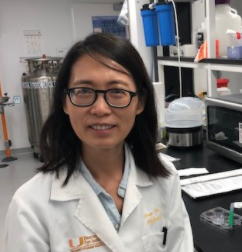
Hong Yu, PhD
BASIC RESEARCH PROJECT
Department of Ophthalmology
Bascom Palmer Eye Institute
University of Miami
Miami, Florida
BASIC RESEARCH PROJECT
Modification of Mitochondrial DNA using targeted CRISPR/Cas9
Scientific Summary: Neuropathy, Ataxia, and Retinitis Pigmentosa (NARP) is a severe mitochondrial disease caused by mutations in mitochondrial DNA (mtDNA), leading to death and blindness in children and young adults. To date, no effective treatment exists. Gene editing provides a promising treatment for this and any other mitochondrial diseases; however, tools that exist for mtDNA manipulation are limited and inefficient. Additionally, gene editing can address future losses but cannot fix the lost cells. Here, we propose to use a novel genetic delivery system to overcome these limitations.
Plans for 2021
Clustered Regularly Interspaced Short Palindromic Repeat/CRISPR Associated Protein 9 (CRISPR/Cas9) provides a powerful strategy for editing nuclear DNA efficiently and precisely. However, it is a challenge to apply this strategy to mtDNA editing because of the difficulty in importing multiple CRISPR/Cas9 components, including nuclease and nucleic acids, into mitochondria. Dr. Yu has developed novel techniques to deliver DNA and protein into the mitochondria of stem cells, and she and her research team plan to use these strategies to deliver CRISPR/Cas9 into NARP patient-derived Induced Pluripotent Stem Cells (iPSCs). This study will allow for correction of the NARP point mutation in the short-term and possibly develop a therapeutic strategy for treating NARP in the long-term.
In 2021, Dr. Yu will continue her research to address how modified mtDNA is selected and repopulated during the patient derived-Induced Pluripotent Stem Cells (iPSCs) genesis and differentiation.
Specific Aims: Aim 1. Test the selection of modified mtDNA during the iPSC-genesis. Aim 2. Test the transmission of the modified mtDNA in iPSC-differentiated retinal neurons.
Progress in 2020
During the 2020 funding year, Dr. Yu fused Cas9 with a mitrochondrial targeting sequence and cloned it into a lentiviral vector, successfully delivered the resulting protein and related materials into mitochondria which facilitated a successful mtDNA editing in a NARP cybrid cell line. Dr. Yu’s work is ongoing, and the data generated thus far partially contributed to a NIH R01 application in addition to gaining further RRF funding.
The specific aims of this project remain 1) to test CRISPR/Cas9- mediated mtDNA editing in NARP patient-derived iPSCs; and 2) to test transmission of the modified mtDNA in iPSC-differentiated retinal neurons.
