

Yingbin Fu, PhD
DANA AND GIL PETRI RESEARCH PROJECT
Cullen Eye Institute
Baylor College of Medicine
Houston, TX
DANA AND GIL PETRI RESEARCH PROJECT
A Novel Treatment Strategy for Age-related Macular Degeneration by Targeting Cholesterol Transport
Major Awards
• 2018 The Helen Juanita Reed Award for Macular Degeneration Research, BrightFocus Foundation
• 2013 Winner of NEI Challenge to Identify Audacious Goals in Vision Research and Blindness Rehabilitation
Current Research Interests
Age-related macular degeneration (AMD) is a major cause of blindness in the elderly. Choroidal neovascularization (CNV) refers to the growth of abnormal leaky blood vessels beneath the retina, the wet type AMD, and underlies 80-90% of legal blindness due to AMD. The current standard treatment does not address the underlying causes of AMD. The objective of this project is to develop a highly innovative and effective holistic treatment for wet AMD by targeting multiple causes of wet AMD via enhancing cholesterol removal from multiple cell types implicated in AMD, thus providing a physiological environment to control pathological blood vessel growth.
Plans for 2021
Dr. Fu’s plans for 2021 are highly innovative and highly significant because they may lead to a novel combination therapy that can benefit a broad spectrum of AMD patients, including choroidal neovascularization (CNV or wet AMD) patients. New treatment strategies for CNV are needed – this is an unmet clinical need. Dr. Fu is researching a novel combination therapy to achieve significantly improved long-term efficacy. This project has the potential to develop the first combination therapy to overcome anti-VEGF resistance in CNV and to significantly improve the current anti-VEGF therapy for a broad spectrum of patients. The long-term objective is to develop a highly innovative and effective treatment for AMD to target three critical components involved in CNV pathogenesis: VEGF, endothelial cells, and macrophages.
Dr. Fu’s specific aims for his 2021 research are Aim 1:Conduct comprehensive trascrptome analysis to elucidate the mechanism of anti-VEGF resistance in AMD and Aim 2: Develop a long-term AIBP/anti-VEGF combination gene therapy for CNV in mouse AMD models.
Progress in 2020 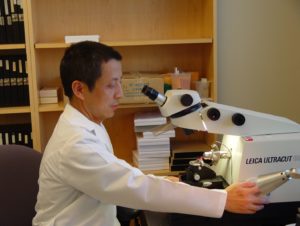
During the 2020 grant period, Dr Fu’s team made the surprising discovery that the combination therapy they were studying shows a synergistic effect in combating anti-VEGF resistance and improves efficacy in treating CNV, actually suppressing CNV.
By using the widely used laser-induced CNV mouse model, Dr. Fu planed to develop an adeno-associated viral vector (AAV) based long-term apolipoprotein A-I [apoA-I]-binding protein (AIBP) therapy for CNV to avoid side effects associated with repeated intraocular injections.
Specific Aims: In 2020, his research tested the hypothesis that AIBP can be an effective therapy for AMD and address the limitations of the current anti-VEGF therapy, such as anit-VEGF resistance, atrophic effect and sub-optimal long-term outcomes, by selectively targeting hyperactive VEGFR2 signaling and simultaneously providing a physiological environment to control angiogenesis. The specific aim was to develop AAV vectors that express AIBP and apoA-I, and test their efficacy in the laser-induced CNV mouse model.
To the best of his knowledge, Dr. Fu’s lab established the first AMD model of anti-VEGF resistance by combining advanced age and laser photo-coagulation. He also provided the first evidence that cholesterol-laden macrophages play a critical role in the introducing anti-VEGF resistance in CNV.
Dr. Fu’s research in 2020 resulted in a patent, two publications, and an additional manuscript is in preparation. 2020 Publications
Progress in 2019
Mechanism and treatment strategies for cone photoreceptor degeneration
Due to the rapid progress made on the LCA project, Dr. Fu proposed to switch focus to developing a novel treatment strategy for AMD in 2019. Another reason to pivot direction relates to the fact that LCA is a rare disease whereas AMD affects a large population in the US, and in the world. In 2019, he assessed the therapeutic efficacy of recombinant AIBP in a widely used mouse AMD model.
2019 Specific Aims: To develop a novel AIBP-based therapy for CNV in mouse AMD models by testing the hypothesis that AIBP can be an effective therapy for AMD and by addressing the limitations of the current anti-VEGF therapy (e.g., anti-VEGF resistance, atrophic effect, and suboptimal long-term outcomes) by selectively targeting hyperactive VEGFR2 signaling and simultaneously providing a physiological environment to control angiogenesis – the development of new blood vessels.
A majority of the proposed experiments in 2019 were completed and Dr. Fu found that AIBP treatment is highly effective in inhibiting laser-induced CNV. Additionally, laser-induced CNV in mice with increased age showed an increased resistance to anti-VEGF treatments, correlating with the increased intracellular lipid accumulation in macrophages. To further investigate the role of AIBP in pathogenic angiogenesis in AMD, they examined the expression and localization of AIBP in human donor eyes from AMD patients and controls and found that AIBP is significantly decreased in human CNV specimen. These results were submitted in a manuscript.
Progress in 2018
A unified mechanism for multiple forms of cone photoreceptor degeneration
The mechanism underlying cone death in Leber’s ongenital amaurosis (LCA) is not well understood. the large number of gene mutations involved and diverse functions affected create a challenge in designing LCA treatments. The goal in 2018 was to identify common mechanisms underlying cone death in order to find a common treatment strategy to protect cones and preserve vision across multiple forms of LCAs. Dr Fu discovered a unified mechanism for cone degeneration in LCA. Namely, S-opsin aggregation induced endoplasmic reticulum (ER) stress is responsible for the rapic degeneration of “S-cones” (i.e., blue cones in humans), and M-opsin degradation associated proteasome stress is a major contributor for “M-cone” (i.e., red/green cones in human) degeneration. This discovery has broad implications for cone degeneration in general.
Dr. Fu’s research team proposed to study the role of two types of cone opsins (light detecting protein in the eye) in the degeneration of cone photoreceptors in Leber’s congenital amaurosis (LCA). Aim 1 was to determine the role of S-opsin in cone degeneration in the GC1–/– model by genetically deleting S-opsin. Aim 2 was to test the hypothesis that genetic deletion of M-opsin in Lrat–/– or GC1–/– mice will significantly reduce proteasome stress and therefore prevent or delay the degeneration of M/L (red/green) cones in both models. They were happy to report that they accomplished the majority of the proposed experiments. For Aim 1, they found that cones can survive at least 9 months after genetic deletion of S-opsin. For Aim 2, they found that genetic deletion of M-opsin reduced proteasome stress and prevented red/green cone degeneration for at least one year.
